
Calpe · Area guide
Calpe
A real year-round town between the Peñón de Ifach and the Salinas wetland — with two fine-sand beaches, seven distinct buying environments and the highest tourist-dwelling share in the cited Alicante comparison.
Geographic scope
What "Calpe" covers.
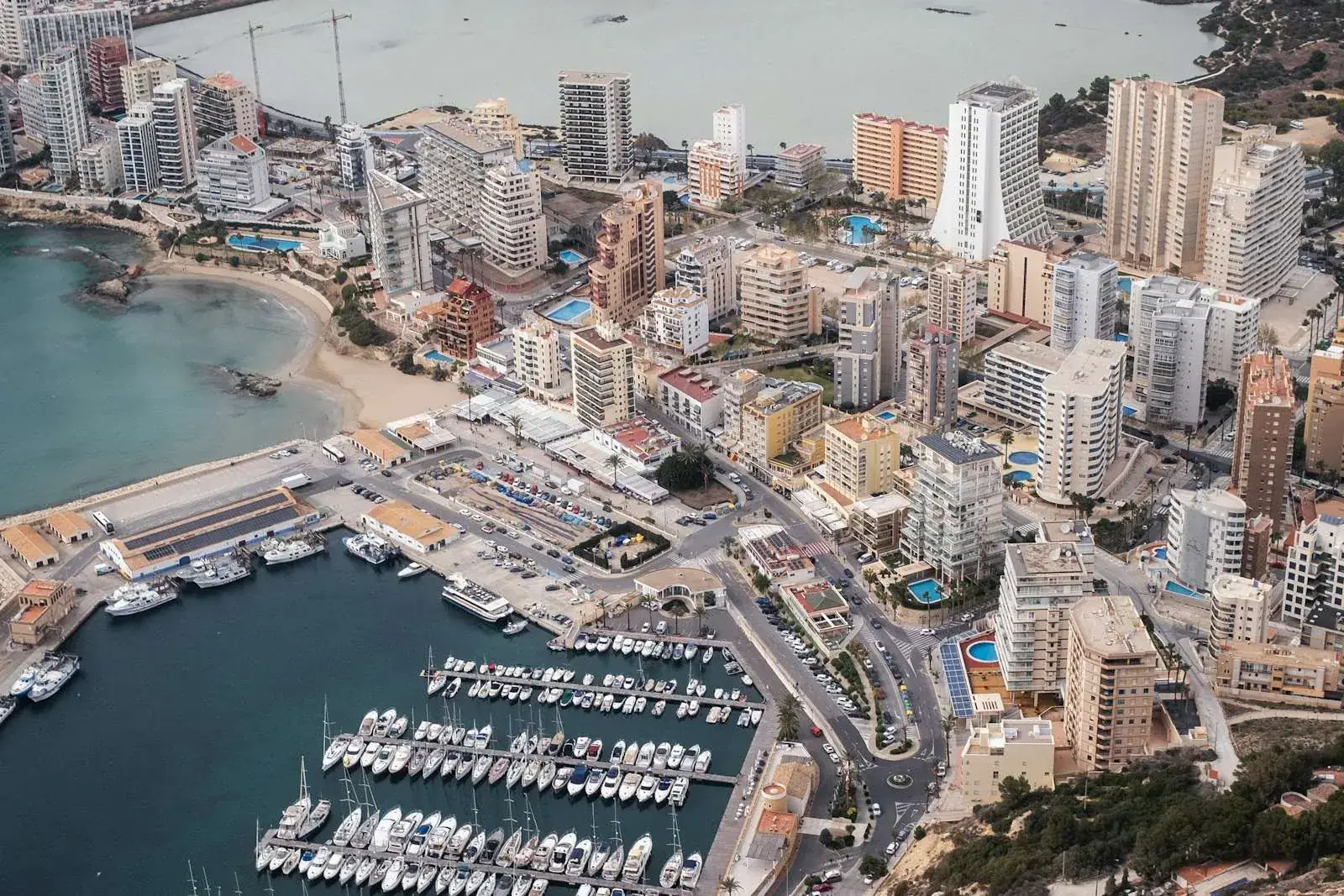
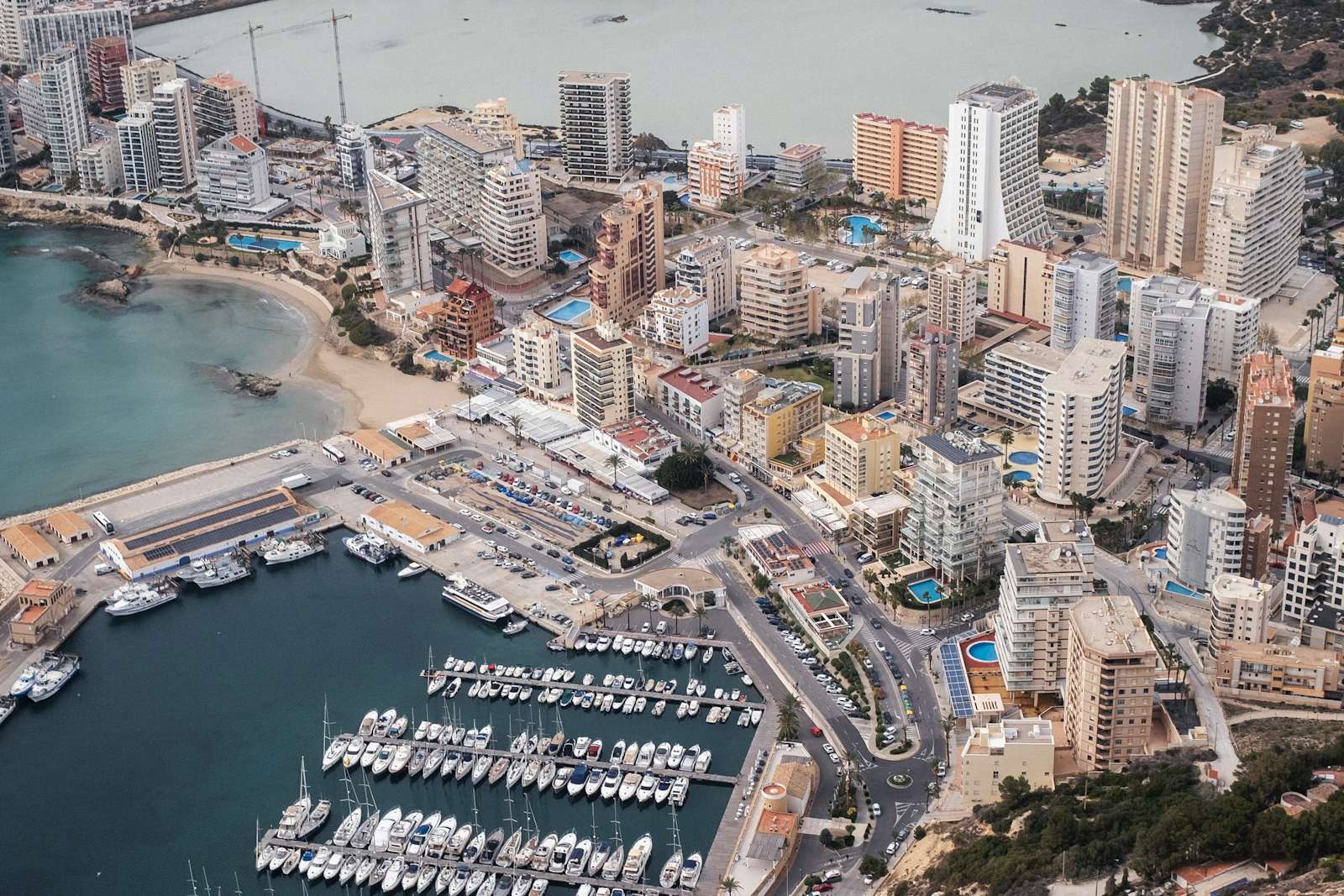
Calpe (officially Calp) sits on the Costa Blanca North, between Altea and Benissa. The municipal territory covers just 23.59 km² — 1,170.52 residents per km² in 2025 — and packs the Peñón de Ifach rock (332 m), the Salinas wetland, two large sandy beaches, a working fishing port and steep western hillside urbanisations into a compact coastal frame. The coastline runs about 13 km with 14 beaches and coves.
The terrain creates three ownership patterns: a flatter, dense and walkable centre-and-beach belt around Arenal-Bol, the Pueblo and the port; a medium-rise architectural coastal belt at Manzanera-Tosal; and dispersed, often steep villa urbanisations — Cometa-Carrió, Canuta, Maryvilla, Gargasindi, Oltamar — west, north and inland.
Municipal profile
Calpe at a glance.
Verified indicators behind this guide — population, density, international share and the two asking indices this market moves on.
How to read these figures
Municipal averages hide extreme internal dispersion — from €2,886/m² in Oltamar-Cucarres to €5,260/m² in Arenal-Bol. All indices are asking prices (June 2026), not completed transactions; live-listing counts are from the 22 July 2026 snapshot.
Where to buy
The seven buying environments.
Calpe is not one market. Pick an environment to see what it is for, what asking prices look like and what ownership runs.
Year-round centre
Calpe Pueblo & old town
June 2026 index · +8.0% YoYThe practical centre with year-round services: older and renovated apartments, penthouses and a small town-house niche. The best daily walkability and the lowest entry point; parking pressure and older buildings are the trade-off.
- Apartments
- €160k–€400k
- Penthouses
- €330k–€650k
- Town houses
- €180k–€700k
- Rental
- Strongest annual logic
Prime beach
Arenal-Bol & Salinas edge
June 2026 index · −4.4% YoYThe highest-priced apartment corridor: broad fine-sand beach, modern high-rise and large terraces, with strong short-stay and seasonal demand. Premium floors and penthouses reach €1.1m–€1.7m+; community systems and future construction are the risks. 241 live listings on the snapshot date.
- Apartments
- €220k–€1.2m+
- Penthouses
- €450k–€1.7m+
- Rent (off-peak)
- €800–€2,600+
- Supply
- 241 live ads
Resort & harbour
Fossa-Levante & Puerto
Fossa €4,227 · Puerto €4,474A dense resort market around the Peñón: frontline towers, the fishing harbour and established holiday complexes. Premiums for height, view and direct beach access; 202 live listings in Fossa-Levante and 87 in Puerto on the snapshot date.
- Fossa apartments
- €180k–€900k+
- Puerto apartments
- €200k–€900k+
- Penthouse rent
- €1.8k–€3k+
- Supply
- 202 + 87 live ads
Architecture
Manzanera-Tosal
June 2026 index · +15.0% YoYA niche for design and architecture buyers: Ricardo Bofill's La Muralla Roja (1972), Xanadú and El Anfiteatro (1983–1985). A genuine architecture purchase — with building-specific technical, waterproofing and restoration questions in ownership.
- Apartments
- €250k–€750k
- Era
- 1972–1985
- Rental
- Thin, design-led
- Watch
- Restoration capex
Hillsides & marina
Canuta–Maryvilla–PortBlanc
Canuta June 2026 index · −1.4% YoYPanoramic villas, coves and nautical infrastructure above the new Marina PortBlanc (opened 22 July 2026 — 144 berths, near-€10m of works). Access, gradient and view set the price; a marina price effect is not yet proven.
- Villas
- €550k–€3m+
- Attached
- €280k–€550k
- Plots
- €150k–€600k+
- Villa rent
- €2.5k–€5k+
Villa belt
Cometa-Carrió & surrounds
June 2026 index · +1.6% YoYCalpe's largest villa and new-build zone, through Gran Sol, Empedrola, Ortenbach and Bassetes — 617 live home listings alone, 587 of them houses or chalets. Maximum choice and custom-build plots; the broad portal label hides big differences in access and beach distance.
- Villas
- €550k–€3.2m+
- Attached
- €240k–€600k
- Plots
- €120k–€500k+
- Supply
- 617 home ads
Space, lower entry
Gargasindi & Oltamar-Cucarres
June 2026 indicesLower-density inland and elevated zones: villas, plots, attached homes and limited apartments at lower asking €/m² than the prime beach zones. The discount is paid in car dependence, slopes and weaker beach liquidity.
- Apartments
- €160k–€350k
- Attached
- €240k–€500k
- Villas
- €450k–€1.3m+
- Plots
- €120k–€450k+
Buyer fit
Market & buyer fit.
Calpe is a real year-round town — 27,440 residents in 2025, a 54.1% foreign-national share, an ageing index of 167.1 — but with a stronger resort and second-home structure than its neighbours: 2,958 tourist dwellings counted in November 2025, 11.31% of the housing stock, among Alicante province's highest concentrations.
Calpe suits buyers who…
Prioritise broad fine-sand beaches and a walkable holiday routine
Want a large choice between high-rise apartments and detached villas in one municipality
Are international second-home owners comfortable with a mature tourism market and seasonal rhythm
Are families who want practical services, supermarkets, restaurants, beaches and water sports close together
Value the iconic landscape — the Peñón, Las Salinas and bay views — as part of the proposition
Are architecture or design buyers drawn to Manzanera's Bofill ensemble, or boating buyers eyeing Puerto, Bassetes and the new Marina PortBlanc
Accept strict legal verification and seasonality as rental investors, rather than assuming uniform year-round income
Calpe suits less well buyers who…
Seek a uniformly low-rise, traditional or culturally quiet coast — Altea or selected Moraira/Benissa locations may fit better
Dislike summer density, traffic, crowded promenades or high-rise skylines
Are strictly car-free but want villa privacy and panoramic views
Require a guaranteed new tourist licence or stable twelve-month occupancy
Expect old Costa Blanca pricing in prime beach zones on a low budget
Are uncomfortable with large communities, lifts, shared facilities and possible special assessments
Have mobility limitations and have not screened steep villa access, duplex stairs or older-tower accessibility
Market snapshot
Prices and supply by district.
Two views of the same June 2026 asking market: the district €/m² index and the absolute asking bands by property type. Both come from the 22 July 2026 listing snapshot.
Asking-price index by subarea — June 2026
Flagged rows are villa-led districts. Maryvilla: no published index.
Asking prices are not transaction prices
These indices measure advertised asking prices, not completed sales. Live-listing snapshot taken 22 July 2026.
By property type — representative asking bands, 22 July 2026
| Type | Representative asking band | Supply |
|---|---|---|
| Apartments | €160k–€550k ordinary resale; €350k–€1.2m+ prime beachfront/new build | Deep |
| Penthouses | €330k–€900k functioning; €1.1m–€1.7m+ trophy/new build | Moderate |
| Villas | €500k–€1.5m mainstream; €1.5m–€3.2m+ luxury | Deep |
| Land | €100k–€450k ordinary urban plot; €500k–€1.5m+ large/licensed/trophy site | Moderate |
| Town houses | €180k–€700k broad central/old-town range | Thin |
| Duplexes | €250k–€700k ordinary; premium beachfront/new-build €800k–€1.7m+ | Thin |
| Country houses | €300k–€900k ordinary/renovation; exceptional compounds €1.5m–€2.25m+ | Thin |
| New-build apartments | ~€300k+ Pueblo, €379k+ Fossa/Salinas, €395k–€455k+ Arenal in sampled schemes | Material |
| New-build villas | ~€730k+ semi-detached; €1.1m–€2.5m+ detached in sampled projects | Material |
| Resale | From €160k–€250k basic central apartments to villas above €3m | Dominant |
Bands are orientation, not valuation
Within every band, price shifts with plot, slope, view corridor, condition and community liabilities. Snapshot: 22 July 2026.
Local conditions
Owning in Calpe: the local conditions.
What shapes daily ownership here — geography, access, tourism and the rules around letting.
Coast, terrain and urban form
The Peñón de Ifach (332 m) divides the Arenal/centre side from La Fossa and the port; the Sierra de Oltà (586 m) closes the municipality off inland. Roughly 13 km of coastline with 14 beaches and coves, and the Salinas wetland — up to 173 bird species — sits inside the urban fabric itself.
Access
The N-332 is the main coastal corridor and brings noise and summer congestion to exposed micro-locations. TRAM Line 9 links Benidorm and Dénia through Calp — back in through service since January 2025 after major works. Alicante-Elche is normally the main international gateway, Valencia the secondary option; the tourist office puts the airports at 70 km and 125 km.
Tourism and seasonality
2,958 tourist dwellings (November 2025) are 11.31% of the housing stock — the highest reported share in the cited Alicante comparison. In summer the population can roughly triple, per Dataestur. That means strong summer demand, but also winter-versus-summer rent gaps, parking pressure and a housing-policy debate that may tighten rules.
Letting and regulation
Of 253 live rental ads on 22 July 2026, 160 were temporary/seasonal. Under Valencian Decree-Law 9/2024 a tourist dwelling is let to the same tenant for ten consecutive days or fewer; it requires a municipal urban-compatibility report and registration is valid for five years. Calp received 985 applications in the first eight months of 2024; no final municipal ordinance was verified.
Anchors and amenities
The fishing port and restaurants around Cantal Roig, Club Náutico Les Bassetes on the Benissa edge and — since 22 July 2026 — Marina PortBlanc: 144 berths after a near-€10m transformation, with beach regeneration and slope stabilisation. Any price effect on the surroundings is not yet measurable.
Year-round services and identity
Supermarkets, schools, health services and sport support permanent residence; the fortified Mudéjar-Gothic church from the early 15th century and the Bofill ensemble give the town an identity beyond the beach. The port keeps a daily fish auction; urban buses link the districts and a tourist office handles visitor information.
Common buyer issues
What goes wrong — and how we check it.
Eight recurring issues from the research brief, each with the practical response we apply before a reservation.
Beach-tower community liabilities
Lifts, pools, façades and garages mean high fees and occasional special assessments. We review budgets, at least three years of minutes, the debt certificate, reserve fund and approved works.
Seasonal rents that mislead
A winter rent or an August month is not a year-round income. We build separate annual, winter and summer cash flows from signed contracts or booking evidence, not portal headlines.
Hillside access, retaining walls and drainage
Maryvilla, Oltamar, Cucarres, Canuta and parts of Cometa are steep. We drive the route in the intended vehicle, check access to the main living floor and have retaining walls and drainage technically reviewed.
Villa legality and split accommodation
Underbuilds, guest apartments and enlarged terraces often fail to match registry and cadastre. We reconcile documents with measured reality and value only lawful, usable space.
Tourist-use assumptions
“Licence included” may be expired, non-transferable or inconsistent with municipal compatibility. We make verified continued operation a documentary purchase condition.
First-line salt, wind and water
Corrosion, wear, terrace leaks and insurance cost come with direct marine exposure. We inspect fixings, glazing, waterproofing and claims history, and visit in different weather.
Salinas-edge expectations
Seasonal water level, birdlife, insects, humidity and environmental constraints come with wetland views. We visit at different times and check official environmental and flood mapping for the parcel.
Plot classification and hidden build cost
Portal land results mix urban plots, urbanisable and rustic land. We obtain a planning certificate, geotechnical input and an all-in project budget before you commit.
Less suitable if…
When Calpe is the wrong town.
Calpe is an outstanding fit for many buyers — and the wrong town for others. Be honest about these points before you fall for a price per m².
You want a uniformly low-rise, traditional or culturally quiet coast — Altea or selected Moraira/Benissa locations fit better
You dislike summer density, traffic, crowded promenades or high-rise skylines
You want villa privacy and panoramic views without a car
You need a guaranteed new tourist licence or stable twelve-month occupancy
You expect old Costa Blanca pricing in prime beach zones on a low budget
You are uncomfortable with large communities, lifts, shared facilities and possible special assessments
From research to listings
Properties for sale in Calpe.
The figures on this page are the background; the listings are the conversation. See what is for sale by type and by environment, or ask us for current, checked matches within your budget — we do not publish a live feed; we send selections the same week.
FAQ
FAQ about Calpe.
Short answers on the town, the market and living there — from the July 2026 research brief.
Where is Calpe and how large is the municipality?
On the Costa Blanca North, between Altea and Benissa. The municipality covers 23.59 km² with 1,170.52 residents per km² (2025) and roughly 13 km of coastline with 14 beaches and coves. Per the tourist office, Alicante is 70 km away and Valencia 125 km.
How many people live in Calpe?
27,440 residents in 2025, with a 54.1% foreign-national share and an ageing index of 167.1 — a genuine year-round town with an international population. The market is multinational; there is no evidence that any single nationality dominates current buying.
What are the seven buying environments?
Year-round Pueblo; prime Arenal-Bol with the Salinas edge; the Fossa-Levante and Puerto resort coast; architectural Manzanera-Tosal; the Canuta–Maryvilla–PortBlanc hillsides; the Cometa-Carrió villa belt; and the roomier Gargasindi/Oltamar zones. They differ materially in price, density, walkability and car dependence.
Is Calpe a year-round town or a resort?
Both. 27,440 residents and year-round services sit alongside 2,958 tourist dwellings (November 2025) — 11.31% of the housing stock, the highest reported share in the cited Alicante comparison. In summer the population can roughly triple, per Dataestur.
What are the beaches like?
Two large urban fine-sand beaches: Arenal-Bol and La Fossa — officially described as a 950-metre fine-sand beach with calm water. Add smaller coves, harbour fronts and the nature reserve on the Peñón (visits by appointment).
How does Calpe compare with Altea, Moraira and Benissa Costa?
Versus Altea: broader sandy beaches, more high-rise and a much larger visible new-build pipeline; Altea is more low-rise, cultural and historic. Versus Moraira: more apartment towers, more year-round services and rail access; Moraira is more low-rise and villa-oriented. Versus Benissa Costa: a complete town with major sandy beaches and deep apartment liquidity; Benissa Costa is more cove- and villa-led.
What is the story with the Bofill buildings?
Ricardo Bofill built La Muralla Roja (1972) and El Anfiteatro (1983–1985) at Manzanera — internationally recognised landmarks with guided tours. They are beloved, but an architecture purchase needs extra technical attention to façades, waterproofing and restoration cost.
When is the best time to buy or view?
Operationally outside the summer peak — but substantively: view your shortlist in more than one season. Summer exposes density, parking pressure and rental dynamics; winter exposes year-round viability, damp and the real atmosphere of an urbanisation.
What do homes in Calpe actually cost now?
The asking-price index was €3,567/m² in June 2026 (+4.5% year on year), with subareas from €2,886/m² (Oltamar-Cucarres) to €5,260/m² (Arenal-Bol). These are asking prices, not transaction prices. Since 1 June 2026 resale ITP is 9% (11% above €1 million); new-build runs 10% VAT plus 1.4% AJD.
Can I manage without a car?
In Arenal, Pueblo, Fossa and Puerto a daily routine can be largely walkable if the building and route are chosen carefully. Cometa, Maryvilla, Oltamar and much of Canuta require a car. TRAM Line 9 has run through between Benidorm and Dénia via Calp since January 2025; urban buses link the districts.
Nearby areas
Compare the neighbouring areas.
Altea
Premium, cultural and calm — the white old town, the church plaza and a slow seafront paseo set the tone.
Coast · privacyBenissa
Coast, village and privacy — villa country between Calpe and Moraira.
Boutique · premiumMoraira
Boutique, premium and calm — quieter than the big resorts.
Quiet · coastalBenitachell
Quiet coastal living between Moraira and Javea, with dramatic clifftop spots.
Premium · variedJavea
Premium and varied — port, old town and beach each with their own character.
Port · north gatewayDenia
Port town at the north end of the Costa Blanca, with ferry links and a real working feel.
Contact with Altea Casas
Looking for a property on the Costa Blanca? Tell us what you’re looking for, and our team will get back to you shortly.